
[
Preliminary Examination: Current events of national and international importance.
Main Examination: General Studies-II, III: Bilateral, regional and global groupings and agreements involving India and/or affecting India’s interests, Effects of liberalisation on the economy.
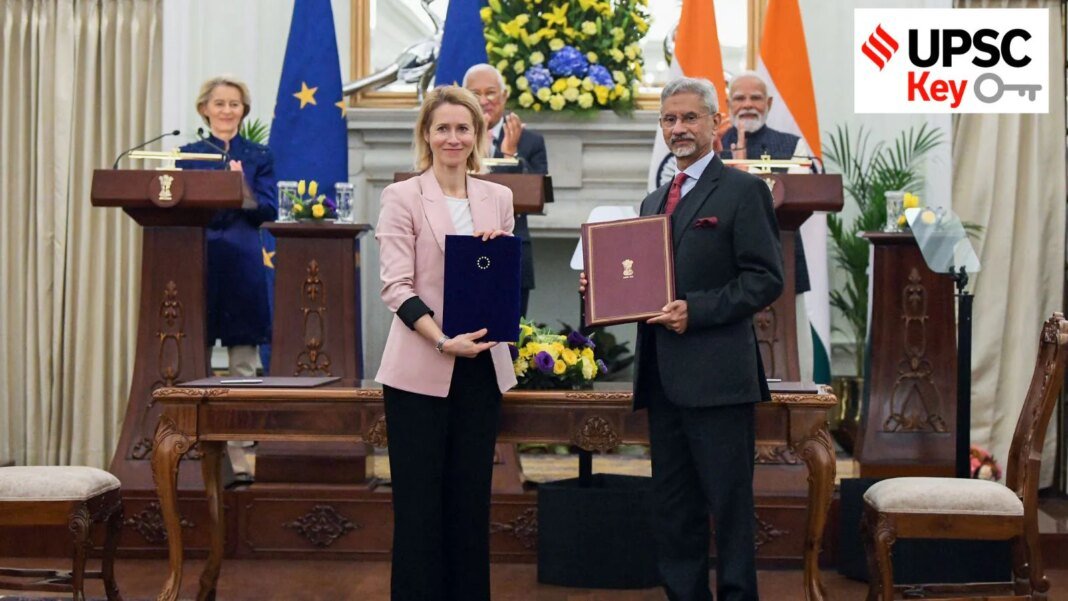
What’s the ongoing story: Sealing what they called “a new blueprint” and the “mother of all deals”, India and the European Union announced Tuesday that they had reached a free trade agreement, “a milestone” in their strategic partnership to deepen economic ties and “drive shared prosperity”.
Key Points to Ponder:
— Know about the EU in detail.
— How have India-EU relations evolved?
— What is the significance of the India-EU trade deal?
— What are the key takeaways of the India-EU Summit?
— What are the deals signed between India and the EU recently?
— Read about the India-EU Security and Defence Partnership.
— What are the challenges in India-EU relations?
— What is Comprehensive and Progressive Agreement for Trans-Pacific Partnership?
Key Takeaways:
— The FTA, clinched after nearly two decades of negotiations between the two sides representing 2 billion people, comes at a time when both India and the EU have been hit by the Trump administration’s steep tariffs, adding urgency to their search for markets elsewhere.
— The pact, once it is vetted and ratified, will eliminate duties on 99.5% of Indian exports, including textiles and gems, while reducing tariffs on 97% of EU goods, such as cars and wine, to 0% in many cases.
Story continues below this ad
— Firming up 13 outcomes at their summit meeting in New Delhi, India and the EU signed the conclusion of the FTA negotiations, a security and defence partnership, a mobility framework and a joint India-European Union Comprehensive Strategic Agenda 2026-2030.
— The joint statement touched upon advances in the India‑Middle East‑Europe Economic Corridor (IMEC), among other connectivity partnerships. This assumes significance as it is widely seen as an answer to China’s Belt and Road Initiative. However, the unrest in West Asia has disrupted the progress of IMEC.
From the Front Page- “After two decades of negotiations, how the deal was clinched“
— The India-European Union (EU) Free Trade Agreement (FTA), nearly two decades in the making, has finally gone through. But there was another point when a trade deal appeared tantalisingly close to fruition — only to be jettisoned. The lessons appear to have been learnt this time.
Story continues below this ad
— The deal attempts to be far more pragmatic. It takes a graded approach to contentious issues such as automobiles and spirits, and has left out agriculture products altogether. And, the key difference from the last time is evolving geopolitics. America’s shadow on global trade and politics has created a broader strategic objective beyond trade gains.
— Geopolitics is the reason why the EU-India relationship has become much more important than it was 20 years ago — when it was upgraded to the level of ‘Strategic Partnership’ without much actual substance.
— The change has much to do with the growing rivalry between China and the US, and their efforts to coerce each other, and other countries.
— A major external factor that propelled the deal was Donald Trump, specifically his tariff actions and penchant for alienating allies. The talks gathered urgency as the dramatic shifts in American trade policies forced countries to scout for newer markets.
Story continues below this ad
— Another key driver of the trade deal has also been the shared challenge of China. Indian industry has been encountering pricing challenges, especially while trying to scale up the solar energy and automotive sectors. The EU is concerned about China’s dominance in critical technologies, as China holds a leading global manufacturing position in several areas, exposing the bloc to potential risks.
— The EU is keen to frame this agreement in a larger, strategic framework that could lead to a closer, strategic relationship that could foster the formation of the new global supply chains to protect both sides from the “huge volatility” that is underway now.
— India is also likely to open its automobile and alcoholic beverage sectors, given the EU’s strong interest in the areas, albeit in a graded manner or akin to terms offered to partners in other deals, especially the UK and Australia pacts. The EU’s goal in the negotiations was to get 97-99% of its exports into India to qualify for “partial or full tariff liberalisation”.
From the Front Page- “Mobility pact eases options for Indian students, workers”
Story continues below this ad
— In a new framework to facilitate movement of people, India and the European Union have signed a mobility pact aimed at easing the movement of Indian students, workers and professionals across 27 EU member countries.
— This comes at a time when the US is making H1-B and other visa routes for Indian citizens more expensive, stricter.
— Under the new framework for mobility, the EU has committed to “an uncapped mobility for Indian students”, according to officials, allowing Indians greater ease to travel, study and work across EU states. There are already around 1.20 lakh Indian students across the EU, with Germany clocking in around 50,000, making Indian students the largest group of international students in the country.
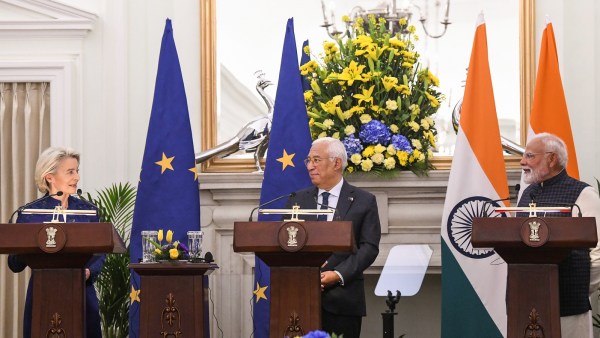 Prime Minister Narendra Modi, with President of the European Council António Luís Santos da Costa, and President of the European Commission Ursula von der Leyen, during the signing of India-EU FTA at Hyderabad House, in New Delhi on Tuesday. (ANI Photo)
— The joint statement said that the leaders highlighted that education and people‑to‑people ties have emerged as vital enablers of the India‑EU Strategic Partnership. They welcomed the conclusion of the India‑EU Comprehensive Framework of Cooperation on Mobility, in line with the national competences of EU Member States and India and domestic legislation of both parties.
Story continues below this ad
— They commended the launch of the first pilot European Legal Gateway Office, as a one‑stop hub to provide information and support the movement of workers, starting with the ICT sector.
From the Politics Page- “Subtle shift: India, EU on same page on Ukraine and Gaza Board”
— In a significant departure, India signed off on a joint statement with the European Union on Ukraine which said they will support efforts based on the principles of “independence, sovereignty and territorial integrity”. This goes against Russia’s interests — having invaded Ukraine in February 2022 violating its independence, sovereignty and territorial integrity.
— India and the EU have so far differed on Russian actions on Ukraine, and these divergences have dominated the Delhi-Brussels discourse over the last four years. This statement is a major shift and a significant evolution in India’s position, which has not explicitly condemned the Russian aggression on Ukraine.
Story continues below this ad
From the Politics Page- “India, EU sign security, defence pacts, condemn terror in all forms”
— India and the European Union on Tuesday signed the India-EU Security and Defence Partnership, the first such overarching defence and security framework between the two sides that will deepen ties in maritime security, defence industry and technology, cyber and hybrid threats, space and counter terrorism, among others.
— The two sides also welcomed the launch of negotiations on a Security of Information Agreement to facilitate exchange of classified information and pave the way for stronger cooperation in security and defence.
From the Politics Page- “Towards 2030:Tech, innovation to power ties”
Story continues below this ad
— PRIME MINISTER Narendra Modi and the visiting European Commission President Ursula von der Leyen and European Council’s President Antonio Costa adopted “Towards 2030: India–EU Joint Comprehensive Strategic Agenda” to elevate strategic cooperation between the two sides.
From the Ideas Page- “For Delhi and Brussels, challenge is to move from breakthroughs to delivery”
— C. Raja Mohan writes- “The translation of prolonged rhetoric into concrete outcomes marks a genuine transformation in the geopolitics of India and Europe. Binding India to Europe — whose economy is now on par with China’s and second only to the US — represents the most consequential trade arrangement Delhi has yet negotiated. It reinforces India’s growing recognition that trade is a crucial element of its national strategy for becoming a developed nation by 2047.”
— “These developments, however, are not accidental byproducts of the current turbulence in Indian and European ties with Donald Trump’s America. Both India and Europe remain deeply invested in their massive economic partnerships with the US and have no intention of weakening their respective security bonds with Washington. What we are witnessing, rather, is a deliberate diversification by both sides — a conscious effort to de-risk their ties with an assertive China and a mercurial America.”
— “This week’s breakthroughs are the cumulative results from that diplomatic investment and political will to overcome entrenched scepticism in both Brussels and Delhi. But India has little time to linger in celebration. Trade liberalisation, once agreed upon in principle, requires enormous bureaucratic mobilisation to move from negotiation to signature to implementation. Defence cooperation, by nature, is slow, and calls for sustained high-level engagement if it is to yield tangible results.
— “India’s partnership with Europe stands at a turning point. The challenge now is to move from breakthroughs to delivery and from frameworks to outcomes. For India and Europe alike, this is a moment not just to diversify partnerships but to expand their agency in shaping the emerging international order.”
From the Explained Page – “How shifting trade winds nudged India-EU talks across finish line”
— Prime Minister Narendra Modi and the President of the European Commission, Ursula von der Leyen, Tuesday announced the formal completion of negotiations on the long-awaited free trade agreement (FTA) at the India-EU summit on Tuesday.
— Although the trade talks first began in 2007, the greatest progress was made in the past six months. From having closed barely seven of the 21 chapters by July last year, both sides managed to wrap up all the chapters last week. The fast-tracking of negotiations coincided with the dramatic use of tariffs by the US, which has triggered anxiety among countries globally, forcing them to scout for newer markets.
— While the EU continues to face threats of US tariffs over its tech regulations and Greenland, Washington has imposed steep 50% tariffs on India since August last year.
— The US tariff threats may have accelerated the India-EU trade negotiations, but India and the EU managed to narrow differences by reevaluating negotiating positions amid rapid geo-economic shifts that have even left multilateral bodies such as the World Trade Organization (WTO) scrambling for relevance.
From the Economy Page- “EU’s ever-expanding regulatory regime is India’s biggest challenge”
— Trade experts said that the India-EU FTA offers India a legal opportunity to leverage its fast-growing consumer market to find a solution to the EU standards that could reverse the gains made under the trade deal. The lack of resolution of EU regulations under the legal agreement could result in considerable asymmetry in the India-EU trade, experts said.
— The European Union, starting January 1 this year, began implementing the world’s first carbon tax. In its current form, CBAM would apply a carbon-related charge to the import of goods from the power sector and energy-intensive industrial sectors, such as cement, steel, aluminium, oil refinery, paper, glass, chemical and fertilisers from countries with lower environmental ambitions and regulations than the European Union.
— But CBAM has provisions for the bloc’s lawmakers to expand the list of items that will bear a levy. India largely exports aluminium, iron and steel to the EU, which are expected to be impacted due to the regulation. India’s steel exports have already begun shrinking during the transition period of CBAM between 2023 and 2025.
— The European Union’s Deforestation Regulation (EUDR), aimed at preventing products sold in the EU from being sourced from deforested land, was scheduled for implementation in December 2024. The European Parliament decided to extend the regulation’s timeline to December 2026.
— Experts have pointed out that India currently does not have compliance standards in place, and the EUDR could pose challenges in exports of food products as the regulation requires extensive compliance procedures, including supplier details as well as addresses of production. Much of the cultivation in India happens by smallholder farmers, making traceability challenging.
Other Important Articles Covering the same topic:
📍Big swap: Automobiles, wine for labour-intensive goods
📍EU-US trade deal may hold the key to carbon tax question”
📍FTA not an end point, marks reform push for the next strategic move
Previous year UPSC Prelims Question Covering similar theme:
(1) Consider the following statements: (UPSC CSE 2023)
The ‘Stability and Growth Pact’ of the European Union is a treaty that:
1. limits the levels of the budgetary deficit of the countries of the European Union
2. makes the countries of the European Union to share their infrastructure facilities
3. enables the countries of the European Union to share their technologies
How many of the above statements are correct
(a) Only one
(b) Only two
(c) All three
(d) None
No discrimination against anybody: Govt after protests on new UGC norms
Syllabus:
Preliminary Examination: Current events of national and international importance
Mains Examination: General Studies-II: Government policies and interventions for development in various sectors and issues arising out of their design and implementation; Welfare schemes for vulnerable sections of the population by the Centre and States and the performance of these schemes.
What’s the ongoing story: Amid protests over the recently notified “equity regulations” for higher education institutes by the University Grants Commission (UGC), Union Education Minister Dharmendra Pradhan said Tuesday that no one would be allowed to misuse the provisions and that “discrimination will not be allowed against anybody”.
Key Points to Ponder:
— What is UGC?
— What do you understand about caste-based discrimination?
— What is reverse discrimination?
— What are the concerns related to discrimination in higher education?
— How does the discrimination of any form violate the spirit of the constitution?
— What are the constitutional provisions related to caste discrimination in India?
— What is the role of education in combating caste discrimination?
— What are the key features of the UGC (Promotion of Equity in Higher Education Institutions) Regulations, 2026? How is it different from the 2012 regulation?
Key Takeaways:
— The UGC (Promotion of Equity in Higher Education Institutions) Regulations, which replace the 2012 equity regulations of the commission, have seen protests by groups, mostly on social media, claiming that these could be used to “harass” general category students and create “caste divisions”. On Tuesday, some students protested outside the UGC office in Delhi seeking the withdrawal of the regulations.
— The main objection that has been raised is that there is no provision for penalties in the regulations against “false complaints of discrimination”, and that institutions can be subjected to action for not complying with the regulations.
— In another change, the notified regulations make a specific mention of OBCs while defining caste discrimination, and call for inclusion of OBC representatives in the ‘equity committees’ to be set up in higher education institutions.
— Sources in the Education Ministry pointed out that the regulations stem from a Supreme Court petition filed by the mothers of Rohith Vemula and Payal Tadvi, who died by suicide over alleged caste-based discrimination, and that this matter remains pending before the Court.
From the Nation page: Plea challenges definition of caste bias in 2026 UGC regulations in SC
— A PLEA before the Supreme Court has challenged the constitutional validity of the University Grants Commission (Promotion of Equity in Higher Education Institutions) Regulations, 2026 claiming it “legitimises reverse discrimination” and amounts to “state-sponsored discrimination” by “refusing to acknowledge the possibility that persons belonging to general or upper castes too may be victims of caste-based discrimination”.
— The writ petition by Advocate Vineet Jindal said the regulations notified on January 13, 2026 “adopts an exclusionary, asymmetric and caste-specific definition of caste-based discrimination”, thereby denying equal protection of law to a substantial section of citizens solely on the basis of caste.
From the Explained section: New UGC regulations sharpen provisions against caste bias
— Two weeks ago, the University Grants Commission (UGC), the regulatory body for higher education in the country, notified regulations to deal with discrimination, including on the basis of caste, in higher education institutions.
— The UGC notified the University Grants Commission (Promotion of Equity in Higher Education Institutions) Regulations, 2026 on January 13. It replaced the similarly named UGC (Promotion of Equity in Higher Educational Institutions) Regulations from 2012.
— The new regulations, which will apply to all higher education institutions, lay down a structure and method for discrimination-related complaints to be made and addressed.
— To implement the objective of these regulations, every higher education institution is mandated to have an Equal Opportunity Centre, an Equity Committee and Equity Squads.
— Equal Opportunity Centre: The Equal Opportunity Centre (EOC) will oversee the implementation of policies related to disadvantaged groups, coordinate with the district administration and police, and help provide legal aid when necessary. These EOCs will have five faculty members from the institution and there is no reservation for any category for these five members.
— Equity Committee: The EOC will have a ten-member Equity Committee chaired by the head of the institution. Five of its members must be from reserved categories — Other Backward Classes, Persons with Disabilities, Scheduled Castes, Scheduled Tribes and women. It is to meet within 24 hours to address complaints, and submit its report to the head of the institutions in 15 days. In turn, the head of the institution is to initiate action within seven days.
— Equity Squads: These are to be constituted to “maintain vigil and prevent discrimination on campus”. They are to “remain mobile and visit vulnerable spots frequently.” Institutions will also have a 24-hour ‘Equity Helpline’ to report incidents of discrimination. They must appoint Equity Ambassadors who will work as “torch bearers” of equity.
— The 2012 regulations were mostly advisory in nature. They stated that “the punishment shall be commensurate with the nature of the discrimination or harassment”.
— They did not provide for action to be taken against an institution that does not comply with the regulations. The new regulations, however, provide for a system for the UGC to monitor their implementation via a national-level monitoring committee.
— Institutions that don’t comply with the regulations can face action — the UGC can debar them from participating in the commission’s schemes, from offering degree programmes and online programmes, or remove the institution from the list of those that are eligible to receive central grants.
— The previous regulations did provide for the creation of Equal Opportunity Cells at institutions, but did not specify their composition and the procedure to be followed in case of an incident of discrimination.
— The new regulations have more detailed provisions for making complaints and the procedures of their disposal, as detailed above.
— The 2012 version also did not specify OBCs anywhere in the regulations, and only stated that “no higher educational institution shall discriminate (against) a student belonging to the Scheduled Castes and the Scheduled Tribes categories”.
— After the draft regulations were made public, concerns were raised about certain sections of it, and changes have been incorporated.
— The final regulations have also done away with a section on ‘false complaints’, which had been included in the draft. The draft had provided for a fine or disciplinary proceedings in case of “false complaints of discrimination”.
Do You Know:
— Since the formation of the UGC in 1956, it has been given the responsibility of determining and maintaining the standards of higher education to be imparted in the country, recognising universities as also allocating funds to them
— The number of reported complaints of caste-based discrimination on university campuses saw an uptick over five years, from 2019—from 173 in 2019-20 to 378 in 2023-24—as per data provided by the University Grants Commission (UGC) to the Parliamentary Standing Committee on Education last year.
— As per UGC data, of the 173 complaints received by institutions in 2019-20, 155 were resolved, while 341 of the 378 complaints received in 2023-24 were reported as resolved. The data was based on details collected from 2,256 higher education institutions, comprising 704 universities and 1,553 colleges.
— This, however, is only a fraction of the total number of higher education institutions in the country –the Education Ministry’s All India Survey on Higher Education 2021-22 records 1,168 universities and 45,473 colleges.
Other Important Articles Covering the same topic:
📍How far can UGC’s new anti-discrimination rules go to address caste on campus? Academics weigh in
📍From 173 to 378, UGC’s 5-year data shows surge in caste discrimination complaints on campuses
Previous year UPSC Prelims Question Covering similar theme:
(2) Which of the following provisions of the Constitution does India have a bearing on Education? (UPSC CSE 2012)
1. Directive Principles of State Policy
2. Rural and Urban Local Bodies
3. Fifth Schedule
4. Sixth Schedule
5. Seventh Schedule
Select the correct answer using the codes given below:
(a) 1 and 2 only
(b) 3, 4 and 5 only
(c) 1, 2 and 5 only
(d) 1, 2, 3, 4 and 5
Previous year UPSC Mains Question Covering similar theme:
“Caste system is assuming new identities and associational forms. Hence caste system cannot be eradicated in India.” Comment. (UPSC CSE 2018)
POLITICS
16 languages,1 portal and 1 reference ID: How Census self-enumeration will work
Syllabus:
Preliminary Examination: Indian Polity and Governance – Constitution, Political System, Panchayati Raj, Public Policy, Rights Issues.
Mains Examination: General Studies-II: Government policies and interventions for development in various sectors, Issues and challenges pertaining to the federal structure.
What’s the ongoing story: People opting for the self-enumeration facility in Census 2027—where they fill, complete and submit the document themselves—will be able to do so in 16 languages. Once they submit their details on the self-enumeration (SE) portal, they will receive a reference ID, which will have to be shared with the enumerator assigned to their locality, The Indian Express has learnt.
Key Points to Ponder:
— What is the census and its history in India?
— Know about the Census Act, 1948 and Census Rules, 1990.
— What is the significance of the census in India?
— How is the census conducted in India?
— What’s new in Census 2027?
— Read about the Office of Registrar General of India.
— What are the powers and functions of RGI?
Key Takeaways:
— Central officials shared these details during a conference of chief secretaries, state nodal officers and directors of Census operations held in New Delhi on January 23, sources said.
— The SE portal will reportedly be available in Assamese, Bengali, English, Gujarati, Hindi, Kannada, Konkani, Malayalam, Manipuri, Marathi, Nepali, Odia, Punjabi, Tamil, Telugu, and Urdu.
— To allow the self-enumeration facility, the Centre had changed the Census Rules, 1990, in March 2022. As per the amended rules, a person can fill, complete, and submit the census schedule through self-enumeration.
— Sources said respondents can log into the SE portal by entering their mobile number—this will be mandatory—and other details. Once a respondent has filled all the questions given in the census schedule, a reference ID (SE ID) will be generated and sent to the registered mobile number of the respondent.
— The Census has been conducted in India since 1872. Census 2027 will be the 16th census overall and the eighth since Independence. The first phase of Census 2027, the Houselisting and Housing Census, is scheduled to begin on April 1 this year. The second phase of the Census, population enumeration, will take place in February 2027.
— The self-enumeration facility will be available from 15 days before the start of house listing operations in a state or Union Territory.
— The Registrar General of India (RGI), which comes under the Ministry of Home Affairs, issued a notification last week regarding the details to be collected during the house-listing process. Details on 33 items, including buildings and assets possessed by households, will be collected. The Centre has approved a budget of Rs 11,718.24 crore for Census 2027.
— The RGI has developed a Census Management and Monitoring System, a web-based platform to manage and monitor various Census 2027 activities. This will allow deployment of enumerators and supervisors and real-time monitoring of data collection, a source said.
Do You Know:
— The Census is a Union subject and is listed at serial number 69 in the Seventh Schedule of the Constitution of India.
— On June 16 last year, the Centre issued a notification declaring its intent to conduct the Census 2027. The notification was issued under the Census Act, 1948, which empowers the Centre to undertake a census in the country.
— The Section 3 of the Census law states, “The Central government may, by notification in the Official Gazette, declare its intention of taking a census in the whole or any part of the territories to which this Act extends, whenever it may consider it necessary or desirable so to do and thereupon the census shall be taken.”
Other Important Articles Covering the same topic:
📍Explained: How India conducts its Census — and what is new in 2027
📍Knowledge Nugget | Census 2027 and Registrar General of India: A must-know for UPSC Exam
📍UPSC Issue at a Glance | Census : 4 Key Questions You Must Know for Prelims and Mains
Previous year UPSC Prelims Question Covering similar theme:
(3) Consider the following statements with reference to the census in India:
1. The first All India Census was attempted in 1872.
2. From 1881, decennial censuses became a regular feature.
Which of the statements given above is/are correct? (UPSC-CDS(II) – 2024)
(a) 1 only
(b) 2 only
(c) Both 1 and 2
(d) Neither 1 nor 2
(Note: The aspirants should also refer to the questions from other competitive exams conducted by the UPSC which might be useful for UPSC–CSE.)
THE IDEAS PAGE
In healthcare, it’s time to shift focus from numbers to quality
Syllabus:
Preliminary Examination: Current events of national and international importance
Mains Examination: General Studies-II: Issues relating to development and management of Social Sector/Services relating to Health, Education, Human Resources
What’s the ongoing story: Vikram Patel writes: The Lancet, the storied medical journal whose pages have been home to publications which have transformed health policy and practice for 200 years, published its first Commission devoted to India on January 21.
Key Points to Ponder:
— What are the challenges facing the health sector in India?
— What are the important government schemes related to the health sector?
— What are the reasons for high out-of-pocket expenditure in India?
— How irrational prescription of medications and diagnostics are leading to antibiotic resistance?
— What is the role of technology in the healthcare sector?
— What are the initiatives taken by the government for the universalisation of the health sector?
Key Takeaways:
— Reforming a health system which caters to a fifth of the world’s population spread across a formidable range of contexts and is deeply fragmented between diverse actors, not least between the public and private sectors, requires examining the health system through diverse perspectives.
— India has made remarkable progress over the past two decades in its mission to realise universal health coverage. There is cross-party consensus on the crucial role of the government, as a financier, provider and steward of the health system.
— The health sector, probably the largest state-run healthcare operation in the world, stretches from over a million community-based health workers across a continuum of facilities with capabilities to address ever-increasing levels of complexity of health problems all the way to sophisticated tertiary hospitals.
— People seem to have no difficulty accessing healthcare, from both the public and private sectors, and although out-of-pocket expenditure as a share of total health expenditure remains amongst the highest in the world, there appears to be a decline in recent years.
— The single greatest challenge, then, is not the availability of doctors, drugs or facilities: It is the poor quality of various components of the health system, starting from the training of healthcare providers to the production of pharmaceuticals and, ultimately, care received by patients.
— Estimates presented in the Economic Survey of 2021 suggested that, in 2018, about 1.6 million deaths in India were attributable to poor quality of care. Incredibly, more people died because of poor quality healthcare than because they were unable to access healthcare.
— One example of how poor quality of care contributes to mortality is the observation that while there has been impressive improvement in healthcare utilisation for antenatal care, low adherence to evidence-based guidelines — such as childbirth protocols — and unavailability of emergency obstetric and neonatal care have emerged as leading causes of maternal and neonatal mortality.
— Multiple studies report serious deficiencies in provider competence, with public and private sector providers often making wrong diagnoses and giving incorrect or unnecessary treatments and diagnostic tests.
— The widespread irrational prescription of medications and diagnostics not only contributes to an astonishing two-thirds share of total out-of-pocket expenditure, but also leads to worse health outcomes for the patient. Such irrational use of medications is also fuelling resistance to antibiotics.
— Quality of care is worse for persons from disadvantaged social groups and for people living in rural or poorer communities.
— However, just as with those sectors, the Commission demonstrates that supply or demand are no longer the primary challenge: The focus must now shift to the quality of those goods.
— To do this, we need a transformation in the culture of the health system, expanding our narrow focus on targets to ensure that what we deliver is of the highest quality, both in terms of science and the experience of the patient. At the heart of this change is a commitment to accountability and integrity by all actors in the health system.
— Additionally, we recommend implementing major reforms of the financing of healthcare and the governance of the health system, remaining steadfast against the inevitable pushback from vested interests who will resist any efforts which threaten their bottom line.
— State, district, and local government institutions must be empowered to design and implement responsive reforms and to be accountable to the communities they serve. Informing citizens of their entitlements and on the performance of their healthcare providers is the practical realisation of citizen-centred healthcare.
— The Commission recognises the unique role of technologies, such as data-driven monitoring of the use of antibiotics or providing digital information to communities about the services in their primary care facility, to catalyse governance.
— Finally, the Commission calls for a learning health system, one that continuously learns from and shares health system data, collaborates in learning networks with other health systems in the country and constantly strives to improve its performance.
Do You Know:
— The Ayushman Bharat insurance scheme was rolled out in 2018 with the aim of providing universal health coverage, especially in a country where a majority of hospital-based care — 60% in urban areas and 52% in rural areas — is provided by the private sector.
— This essentially means that the scheme has been able to prevent people from dipping into their savings or going into debt to afford care that they were anyway accessing at private hospitals. This is affirmed by the reduction in out-of-pocket expenditure even as the government expenditure has increased.
— PMJAY is for inpatient secondary and tertiary care. Outpatient services are not a part of the scheme. The latter component is being addressed through Ayushman Arogya Mandirs (AAMs), earlier called Health and Wellness Centres. With over 1,75,000 AAMs free consultations and many medicines (up to 172) and diagnostics (up to 63) are being provided free.
— AB PM-JAY is the world’s largest public health insurance scheme. It provides free cover up to Rs 5 lakh annually to all members of eligible families — estimated to comprise the bottom 40% of the population economically — irrespective of age.
Other Important Articles Covering the same topic:
📍The road to Universal Health Coverage in India
Previous year UPSC Prelims Question Covering similar theme:
(4) Consider the following statements: (UPSC CSE 2023)
Statement-I: India’s public sector health care system largely focuses on curative care with limited preventive, promotive and rehabilitative care.
Statement-II: Under India’s decentralized approach to health care delivery, the States are primarily responsible for organizing health services.
Which one of the following is correct in respect of the above statements?
(a) Both Statement-I and Statement-II are correct and Statement-ll is the correct explanation for Statement-I
(b) Both Statement-I and Statement-ll are correct and Statement-ll is not the correct explanation for Statement-I
(c) Statement-l is correct but Statement-ll is incorrect
(d) Statement-l is incorrect but Statement-ll is correct
Previous year UPSC Mains Question Covering similar theme:
“Besides being a moral imperative of Welfare State, primary health structure is a necessary pre-condition for sustainable development.” Analyze. (UPSC CSE 2021)
EXPLAINED
US quits Paris deal, but has chosen to remain in some climate bodies
Syllabus:
Preliminary Examination: Current events of national and international importance
Mains Examination: General Studies-II: Important International institutions, agencies and fora- their structure, mandate.
What’s the ongoing story: Earlier this month, the United States withdrew itself from over 60 major international organisations and agreements saying these no longer served American interests.
Key Points to Ponder:
— What are the reasons for the recent withdrawal of the US from international organisations?
— How does it impact the funding and attaining the objective of the international organisations?
— How is it going to impact the fight against climate change?
— What is the Paris Agreement?
— Know about the objective of these organisations: UN Framework Convention on Climate Change (UNFCCC), Intergovernmental Panel on Climate Change (IPCC), International Renewable Energy Agency (IRENA), International Solar Alliance (ISA), International Union for Conservation of Nature (IUCN), UN Environment Programme (UNEP), World Meteorological Organisation (WMO), and International Energy Agency (IEA)
Key Takeaways:
— The most high-profile of these exits related to environment and climate-related treaties and groups like the UN Framework Convention on Climate Change (UNFCCC), Intergovernmental Panel on Climate Change (IPCC), International Renewable Energy Agency (IRENA), International Solar Alliance (ISA), International Union for Conservation of Nature (IUCN) and a few others.
— US President Donald Trump’s contempt for climate action is well-known. He has described climate change as a ‘hoax’, and pulled his country out of the 2015 Paris Agreement immediately after assuming office for the second time in January last year.
— However, the United States has not exited from all such organisations or agreements. It pulled out of 31 UN entities but not from the UN Environment Programme (UNEP), which has a significant footprint on global climate policy and discussions. It has quit IRENA but not the International Energy Agency (IEA), whose work also influences global energy transitions.
— Similarly, the US has withdrawn from IPCC, the scientific body that produces periodic assessments of climate science, but not the World Meteorological Organisation (WMO), which too produces climate science and happens to be the host of IPCC.
— There are quite a few other organisations and agreements related to environment, energy and climate that the US is still a member of.
— One of those interests could be to ensure that a few important international agreements currently under discussion are aligned with American priorities. For example, since 2022, the UNEP has been facilitating talks on a Global Plastics Treaty, which is to be a legally-binding international instrument to curb plastic pollution, including in the oceans.
— The US is one of the largest producers of plastics, which are made from fossil fuels, and it is important for it to ensure that the eventual agreement does not jeopardise its industry… But the Trump administration clearly does not see it as profitable to disengage from this conversation at the current stage.
— Somewhat similar is the case with discussions on shipping emissions happening under the International Maritime Organization (IMO). One of the goals of the discussion is to finalise a net-zero emissions framework for 2050, which involves, among other things, the imposition of a tax on carbon emissions from ships.
— This too was supposed to be finalised last year, but ran into trouble due to opposition from the United States and the same set of other players.
— A good comparison could be that between IRENA, from which the US has withdrawn, and IEA, from which it has not.
— Both are energy-related institutions, and seek to promote energy access, availability, and fair and equitable energy policies. But IRENA’s core objective is to push the deployment of renewable energy. It does not align with the priorities of the Trump administration, which wants to use more oil and gas.
— The IEA was formed in 1974 to ensure the security of oil supplies. Though it has also been promoting sustainable energy in recent years, it is not ideologically inclined towards renewable or clean energy.
— The case of the World Meteorological Organization, a UN agency, is somewhat similar. WMO produces a lot of climate science, but its main job is global weather forecasting, ocean and atmospheric monitoring, disaster early warning, and weather data and analysis.
Do You Know:
— Zerin Osho writes: US actions were hardly unexpected. Donald Trump’s renewed assault on climate multilateralism follows a familiar script: Withdrawal, obstruction, and indifference to scientific consensus.
— His decision to pull the US out of the UN Framework Convention on Climate Change and disengage from the Intergovernmental Panel on Climate Change does not alter a single physical reality of the climate system. Temperatures will keep rising. Seas will continue to swell. Extreme weather will intensify.
— Nor does the exit from over 60 other treaties and multilateral bodies reverse the economic direction of travel, as investment in low-carbon energy continues to outpace fossil fuels. What it will do, however, is dry up funding for many non-profit organisations working on climate action and introduce friction into a narrative of inevitability that had begun to take root among governments, markets, and the public.
Other Important Articles Covering the same topic:
📍US leaves India-headquartered International Solar Alliance after Trump order: What to know
📍Trump withdraws US from 66 global organisations: Here’s the full list
Previous year UPSC Prelims Question Covering similar theme:
(5) With reference to the Agreement at the UNFCCC Meeting in Paris in 2015, which of the following statements is/are correct? (UPSC CSE 2016)
1. The Agreement was signed by all the member countries of the UN and it will go into effect in 2017.
2. The Agreement aims to limit the greenhouse gas emissions so that the rise in average global temperature by the end of this century does not exceed 2°C or even 1.5°C above pre-industrial levels.
3. Developed countries acknowledged their historical responsibility in global warming and committed to donate $1000 billion a year from 2020 to help developing countries to cope with climate change.
Select the correct answer using the code given below.
(a) 1 and 3 only
(b) 2 only
(c) 2 and 3 only
(d) 1, 2 and 3
| ALSO IN NEWS | |
| Acid attacks: SC for harsher measures like in dowry death | The Supreme Court on Tuesday sought to know if there can be legislative intervention to ensure harsher measures to deal with acid attack cases, including shifting the burden of proof on the accused like in dowry death cases.
The CJI also suggested attaching the assets of the convicts in acid attack cases so that they can be auctioned and the money be paid to the victim. Following this, the court asked states and Union Territories to furnish details on incidents of acid attack reported year-wise, how many instances of forced ingestion of acid, whether chargesheets in those cases were filed, how many cases have been decided and how many are still pending at the trial stage, particulars of each victim of acid attack, their educational qualifications, current employment status, marital status, medical treatment, details of the expenditure incurred or committed to be incurred by the state on such treatment and on the rehabilitation scheme for the victims of acid attacks. |
| JJM funds to states only after 15-day constant supply of water | STATES WOULD receive funds under the Jal Jeevan Mission (JJM) only after signing of separate MoUs, with each scheme mapped through a unique Scheme ID and future releases linked to the demonstration of 15 days of continuous water supply, Union Jal Shakti Minister C R Patil said on Tuesday. |
| The Ideas Page: Let’s do away with Governor’s special address | Tanvir Aeijaz writes: Article 176(1) of the Constitution makes for a provision of “special address” by the governor, and it mandatorily obligates him, by the sheer use of the word shall, to read the policy speech handed to him by the government. The constitutional convention of addressing the first session of each year and at the commencement of the first session after each general election, both by the President and the governor, is a colonial hangover.
We do not find anywhere in the Indian Constitution or in any interpretation that the governor has the right to omit or express his mind on the opening day. On behalf of the people of the state, the state government expresses through the governor, who needs to act as the mouthpiece of the programmes, policies, and prevailing conditions of governance. |
| PRELIMS ANSWER KEY |
| 1. (a) 2. (d) 3. (c) 4. (b) 5. (b) |
Subscribe to our UPSC newsletter. Stay updated with the latest UPSC articles by joining our Telegram channel – IndianExpress UPSC Hub, and follow us on Instagram and X.
🚨 Click Here to read the UPSC Essentials magazine for January 2026. Share your views and suggestions in the comment box or at manas.srivastava@indianexpress.com🚨