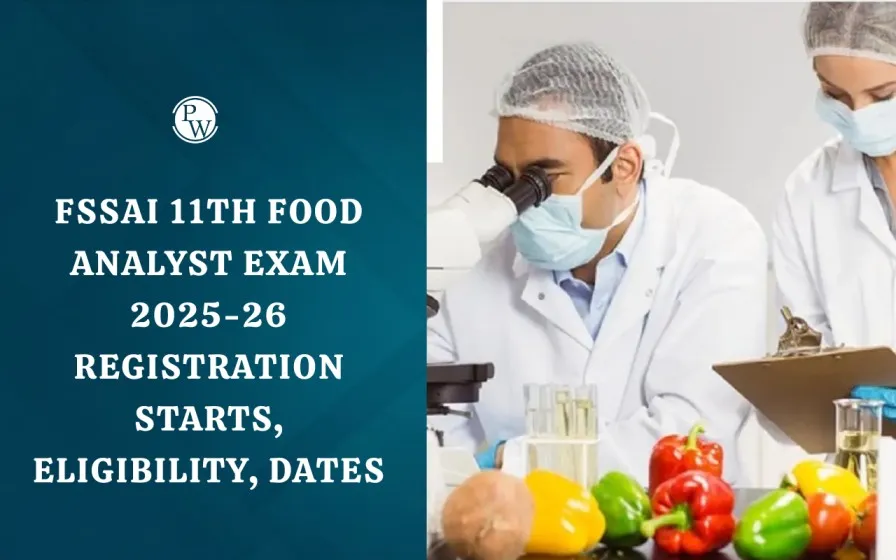

FSSAI Food Analyst Exam 2025 (11th FAE 2025) — — official details, eligibility, important dates, syllabus & how to apply:
ELIGIBILITY CRITERIA FOR 11th FOOD ANALYST EXAMINATION (11th FAE) 2025
Applications accepted online for those who meet the required education criteria along with three years of relevant work history, as outlined in sub-rule (ii), Rule 2.1.4 of the Food Safety and Standards (First Amendment) Rules, 2022, under the Food Safety and Standards Act, 2006.
A degree matters here – options include chemistry, biochemistry, or microbiology. One path leads through dairy chemistry, another through agriculture science. Animal science fits, so does fisheries science. Think biotechnology, food safety, even food technology. Degrees in nutrition, dairy tech, oil tech, or veterinary sciences also count. The school must be legally recognized in India. Or there’s this route: pass the food analyst exam run by the Institution of Chemists (India). Being linked to that group works too.
Working with food analysis for at least three years is expected. This time must come after getting the required education listed earlier for 11th FAE 2025. Any lab or research body counts toward this period. Real hands-on work matters most here. Time spent learning on the job builds necessary skills. Past roles in testing centers also qualify. What counts is doing actual tests on food samples. Training under supervision helps too. Length of practice shows depth of understanding. Doing similar tasks repeatedly sharpens ability. Exposure to real projects shapes readiness. Most useful insights come from daily challenges faced. Long-term involvement proves consistency.
A handful of junior analysts, once they’ve spent three full years studying food details, might step into the 11th FAE 2025 hands-on test – but only if they cleared the computer screening first. Getting that chance at the practical round happens just one time, never repeated. Passing it unlocks their shift from junior status straight to official food analyst roles. For these exam-passed juniors, the door opens but once, then stays shut.
Anyone can try out for the 11th FAE 2025, regardless of how old they are. The event does not set a minimum or maximum age. People of any generation may take part. It doesn’t matter if you’re young or have many years behind you. Participation stays open across all ages. Not one single person gets turned away just because of their birth year.
Fifty rupees short of three thousand, that is two thousand five hundred, marks the cost for the computer test – add eighteen percent tax on top. Double that amount, reaching five grand, covers the hands-on exam, again with the same extra charge from the government. Paying happens only by internet methods, no other way around it. Once sent, getting money back? Not an option.
What is the FSSAI Food Analyst Exam?
The Food Analyst Examination (FAE) is conducted by the Food Safety and Standards Authority of India (FSSAI) to certify professionals as Food Analysts.
Qualified Food Analysts are legally recognized to conduct food testing in FSSAI-approved laboratories across India. (FSSAI)
11th FAE 2025 – Key Dates
(For the 11th Food Analyst Examination 2025–26)
| Event | Date |
| Online Application Starts | 23 Dec 2025 (Tentative) |
| Last Date to Apply | 22 Jan 2026 |
| Admit Card for CBT | From 24 Feb 2026 |
| Computer Based Test (CBT) | 8 Mar 2026 |
| Answer Key Publication | 10 Mar 2026 |
| CBT Results | 23 Mar 2026 |
| Practical Exam Application | 3 Apr 2026 – 10 Apr 2026 |
| Practical Exam (Batch-I) | 25–26 Apr 2026 |
| Practical Exam (Batch-II) | 2–3 May 2026 |
| Mandatory Training | 25 May – 5 Jun 2026 |
| Issue of Certificate | 5 Jun 2026 |
Note: Though called the 2025 exam, the CBT and later stages happen in early 2026.
Eligibility Criteria
To appear in the 11th FAE 2025, candidates must have:
Educational Qualifications
✔ Bachelor’s / Master’s / Doctorate degree in relevant science streams such as:
- Chemistry / Microbiology / Biochemistry
- Food Technology / Food Safety & Nutrition
- Dairy Chemistry / Agriculture / Animal Science
- Biotechnology / Fisheries / Veterinary Sciences / Oil Technology
(from a recognized Indian university or equivalent)
Experience Requirement
✔ Minimum 3 years’ experience in food analysis in a recognized laboratory or institution after obtaining the essential academic qualification.
Age & Other Requirements
– No upper age limit specified in the official notification.
– Documents submitted must match the application details exactly.
Exam Pattern & Syllabus (CBT)
Computer Based Test (CBT)
- Objective type (MCQs)
- Total Questions: 200
- Marking: +4 per correct; –1 per wrong (FSSAI)
Main Syllabus Sections (Approx % weightage)
| Topic Area | % Weightage |
| Food Laws & Standards (India & International) | 25% |
| Food Chemistry | 35% |
| Laboratory setup & standards (NABL/ISO) | 15% |
| Food Microbiology & Hygiene | 35% |
| Physical, Chemical & Instrumental Analysis | 10% |
| Nutrition | ~7.5% (also part of overall syllabus) |
✔ Questions cover both chemical and biological analyses. (FSSAI)
✔ Detailed official syllabus PDF is available on the FSSAI portal. (FSSAI)
Practical Examination & Training
After clearing the CBT:
- Practical exams are held in batches (late April – early May 2026).
- This includes hands-on analysis of food samples, contaminants, microbiological tests, instrumental methods, etc. (FSSAI)
- Mandatory training follows practicals (late May – early June).
- Final certificates issued after training completion.
Exam Fees (indicative)
Some reports suggest CBT and Practical exam fees (separate) — e.g., ₹2,500 for CBT + ₹5,000 for practicals (GST included), but check the official notification once published.
How to Apply
- Visit the official FSSAI Food Analyst Portal or the FSSAI website. (FSSAI)
- Fill in the online application between 23 Dec 2025 – 22 Jan 2026.
- Upload required documents and pay the fee online.
- Download admit cards when available.